The Stoic Playbook: 5 Ancient Principles That Quietly Power Today's Most Effective Leaders
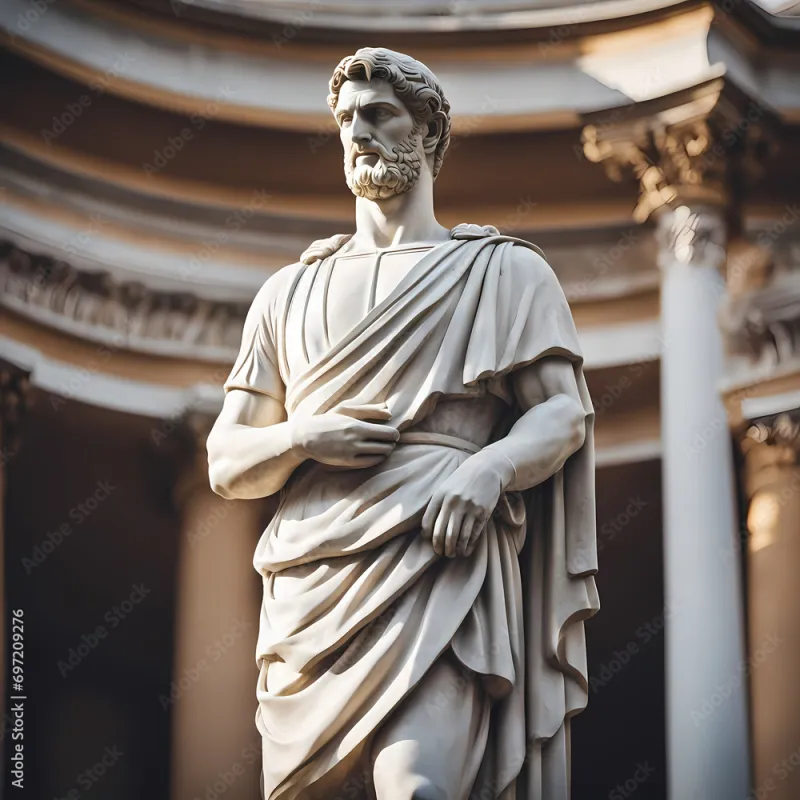
Photo: stoic philosophy ancient Rome marble statue modern businessman leadership, via as1.ftcdn.net
Long before productivity apps, executive coaches, or performance optimization podcasts, a group of philosophers in ancient Greece and Rome developed a rigorous system for living well under pressure. Stoicism, once confined to dusty academic syllabi, has found an unlikely second home among entrepreneurs, athletes, and executives navigating the relentless demands of modern achievement. Here is what they are actually practicing—and why it works.
The appeal is not difficult to understand. Hustle culture, for all its initial seductiveness, has revealed a significant design flaw: it is not sustainable. Burnout rates among high-achieving Americans have reached historic levels, and the relentless optimization mindset—more output, less sleep, faster growth—has left many successful people feeling hollow despite their accomplishments. Into this vacuum, the ancient Stoics offer something refreshingly different: not a strategy for doing more, but a philosophy for thinking better.
Marcus Aurelius, who governed the Roman Empire during one of its most turbulent periods while simultaneously maintaining a rich interior life, and Epictetus, a former slave who became one of antiquity's most respected teachers, are among the figures whose writings have quietly migrated from philosophy seminars into the reading lists of some of today's most effective leaders. What follows are five of the principles they championed—and the very modern reasons those principles endure.
1. The Dichotomy of Control: Stop Managing What You Cannot Own
Epictetus opens his Enchiridion with a distinction so simple it is easy to underestimate: some things are within our control, and some things are not. Within our control are our judgments, intentions, and responses. Outside our control are outcomes, other people's behavior, market conditions, and the passage of time.
For leaders operating in volatile industries—whether technology, finance, or healthcare—this distinction is not merely philosophical; it is operationally essential. The executive who exhausts herself managing her company's stock price is directing energy toward something fundamentally beyond her governance. The one who redirects that energy toward the quality of her decisions, the clarity of her communication, and the integrity of her process is practicing what Epictetus prescribed two thousand years ago.
This principle does not counsel passivity. It counsels precision. By identifying what genuinely lies within one's sphere of influence and concentrating effort there, leaders avoid the corrosive anxiety that accompanies the illusion of total control. It is, in essence, a philosophy of strategic focus dressed in ancient robes.
2. Negative Visualization: Rehearsing Difficulty to Neutralize It
The Stoics practiced a discipline they called premeditatio malorum—the premeditation of adversity. Rather than avoiding thoughts of what could go wrong, they deliberately imagined setbacks, losses, and failures in advance. The purpose was not pessimism but psychological preparation: by mentally rehearsing difficulty, the practitioner diminishes its power to destabilize when it actually arrives.
This practice sits in sharp contrast to the relentlessly positive framing that dominates much of American motivational culture. Yet its effectiveness is increasingly supported by research in cognitive psychology. Gabriele Oettingen's work on mental contrasting—a technique that pairs positive goal visualization with honest acknowledgment of potential obstacles—consistently outperforms pure positive thinking in predicting follow-through and resilience.
For the entrepreneur facing a product launch, the investor navigating a bear market, or the executive managing a leadership transition, negative visualization is not defeatist. It is preparation. The Stoics understood that the mind which has already faced its fears in imagination is far steadier when those fears materialize in reality.
3. Amor Fati: The Transformative Power of Radical Acceptance
Marcus Aurelius wrote, in his private journal later published as Meditations, that one should love everything that happens—not merely tolerate it, not simply endure it, but embrace it as necessary and, in some sense, chosen. The philosopher Friedrich Nietzsche later named this disposition amor fati: love of fate.
For contemporary leaders, this principle addresses one of the most psychologically costly habits in high-performance environments: resistance to what has already occurred. The failed product launch, the departed key employee, the regulatory setback—none of these can be undone. Yet enormous cognitive and emotional energy is routinely spent in the psychological equivalent of arguing with the past.
Amor fati does not require pretending that adverse events are pleasant. It requires recognizing that one's response to those events is the only variable that remains actionable. Athletes who recover most effectively from injury, research suggests, tend to be those who accept the reality of their situation most quickly—not those who are most naturally optimistic. The Stoic insight here is practical, not merely inspirational.
4. Memento Mori: Mortality as a Clarifying Force
The phrase memento mori—remember that you will die—strikes modern sensibilities as morbid. The Stoics considered it clarifying. Marcus Aurelius returned to the theme of mortality repeatedly in Meditations, not to induce despair but to sharpen his sense of what actually mattered. When time is understood as finite and non-renewable, trivial concerns lose their grip and genuine priorities become easier to identify.
In an era defined by information overload, notification saturation, and the pressure to respond to everything immediately, the Stoic practice of mortality awareness offers a powerful filtering mechanism. Before investing significant time and attention in any endeavor, the implicit question becomes: given the finite nature of my life, is this genuinely worth my engagement?
This is not a counsel of morbidity. It is an invitation to intentionality—to construct a life organized around authentic values rather than reactive urgency. For leaders who find themselves perpetually busy yet persistently unfulfilled, memento mori is less a reminder of death than a prompt toward life.
5. The Inner Citadel: Protecting Sovereignty of Mind
Marcus Aurelius described the disciplined mind as an inner citadel—a fortress that external circumstances, no matter how turbulent, cannot breach without the occupant's consent. The quality of one's inner life, the Stoics argued, is the only domain over which genuine sovereignty is possible, and therefore the only domain worth defending with full commitment.
In the context of contemporary leadership, this principle speaks directly to the challenge of constant connectivity. The average American professional checks their phone dozens of times daily, frequently in response to demands that feel urgent but are rarely important. Each such interruption represents a small surrender of the inner citadel—a moment in which external noise is permitted to determine the direction of attention.
Building the inner citadel in practical terms means establishing deliberate boundaries around attention: structured periods of deep work, intentional disconnection, and regular reflection. It means recognizing that the most valuable resource any leader possesses is not capital, network, or talent—it is the quality of their sustained, undivided thought.
Ancient Wisdom for an Accelerating World
Stoicism does not promise ease. Its practitioners—from a Roman emperor managing barbarian invasions to a Greek slave navigating the brutality of his condition—faced circumstances that make most modern challenges appear modest by comparison. What Stoicism offers is not comfort but capacity: the cultivated ability to meet whatever arrives with clarity, equanimity, and purposeful action.
In a cultural moment hungry for sustainable excellence, that ancient promise feels remarkably current.
