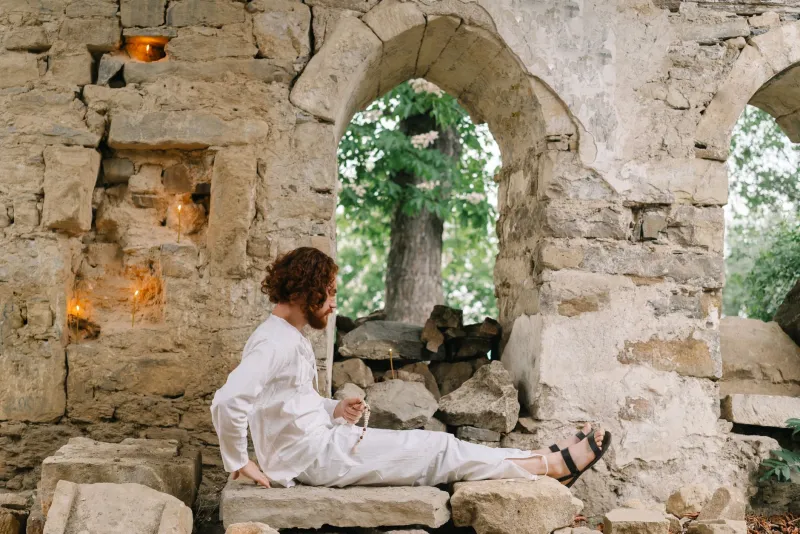
Alone Together: How Ancient Solitude Rituals Secretly Unlock the Capacity for Deeper Human Connection

There is a quiet crisis unfolding inside American relationships. Despite living in the most connected era in human history — smartphones buzzing, group chats humming, video calls bridging continents — a growing number of people report feeling profoundly unknown by those closest to them. Therapists speak of couples who share a bed but not a thought. Friends who text constantly yet confide in no one. The paradox is impossible to ignore: we are more reachable than ever, and yet somehow, less truly reached.
Ancient civilizations, across vastly different geographies and belief systems, appear to have anticipated this very dilemma. And their solution, counterintuitive as it sounds, was not more togetherness. It was structured, intentional solitude.
The Wisdom Hidden in Withdrawal
To the modern mind, solitude often carries the faint scent of failure — a sign of social rejection, introversion, or worse, loneliness. But in classical traditions, deliberate withdrawal was considered a form of rigorous preparation. It was not a retreat from community; it was a retreat for community.
Consider the vision quest, practiced across numerous Indigenous North American cultures. Young people entering adulthood were sent alone into the wilderness — sometimes for days — without food, companionship, or distraction. The purpose was not punishment or isolation. It was initiation. The solitary ordeal was designed to strip away the noise of social performance and force a confrontation with the self. Only after this inward journey could the individual return to the tribe as a full, contributing presence — someone who brought genuine depth to the collective, rather than merely occupying space within it.
The logic embedded in this ritual carries extraordinary relevance today. A person who has never sat with their own thoughts, fears, and desires cannot offer authentic presence to another. They can offer proximity. They can offer distraction. But presence — the kind that makes another person feel truly seen — requires a self that has first been genuinely examined.
What Monasticism Understood About Love
The monastic traditions of both East and West built entire architectures around this principle. Christian contemplatives in the Desert Father tradition, Buddhist monks in the Theravada lineage, Hindu sannyasis — all practiced forms of intentional withdrawal that were not understood as antisocial, but as spiritually generative. Thomas Merton, the twentieth-century Trappist monk whose writing reached millions of American readers, argued that solitude was not the enemy of love but its very school. "It is in deep solitude," he wrote, "that I find the gentleness with which I can truly love my brothers."
This is not merely poetic sentiment. It reflects a sophisticated understanding of human psychology that modern relational science is only beginning to validate. When we are perpetually surrounded by others, we tend to borrow our sense of self from the group — mirroring moods, adopting opinions, performing versions of ourselves calibrated for approval. Solitude interrupts this borrowing. It forces the question: Who am I when no one is watching? And the answer to that question, however uncomfortable to arrive at, is the foundation upon which genuine intimacy is built.
The Modern Relationship Problem Is a Presence Problem
Relationship therapists across the United States increasingly describe a phenomenon that might be called proximity without presence. Partners physically occupy the same space while mentally inhabiting separate digital universes. Friends gather for dinner while simultaneously broadcasting the gathering to strangers online. The body is present; the self is elsewhere.
This is not simply a technology problem, though technology accelerates it. It is a depth problem — and depth, ancient traditions consistently taught, is cultivated in stillness and solitude, not in stimulation and constant social engagement. The Roman philosopher Seneca observed that a person who is a stranger to themselves cannot be a genuine companion to others. Two thousand years later, attachment researchers echo a strikingly similar insight: individuals with a poorly developed sense of self-identity tend to form relationships characterized by enmeshment, avoidance, or chronic misattunement.
The ancient prescription was not complicated. It simply required courage: the willingness to spend time alone, in silence, without agenda.
Reclaiming the Practice — Without a Wilderness
Very few Americans will undertake a multi-day vision quest or enter a monastery for a season of contemplation. But the underlying principle is scalable. Ancient solitude was not defined by its duration or its setting. It was defined by its quality — the intentional turning of attention inward, away from social performance and toward honest self-encounter.
There are accessible modern translations of this practice worth considering:
Morning silence before engagement. Many contemplative traditions prescribed a period of silence before the day's social demands began. Even thirty minutes of quiet — without a phone, without news, without conversation — can establish a quality of inner groundedness that changes how one shows up for others throughout the day.
Solo time as relational investment. Framing occasional solitary walks, journaling sessions, or even solo meals not as self-indulgence but as preparation for deeper connection shifts the cultural guilt that often surrounds time spent alone. You are not withdrawing from your relationships. You are investing in the self that your relationships need.
Periodic digital fasting. The ancient withdrawal ritual was partly about removing the voices of others so that one's own voice could be heard. A weekend without social media, or even a single evening of genuine disconnection, can serve a structurally similar function — quieting the ambient noise of collective opinion long enough for individual clarity to emerge.
Contemplative retreats. Secular and spiritually inclusive retreat centers across the United States — from Insight Meditation Society in Massachusetts to Spirit Rock in California — offer structured periods of guided silence that carry the essential architecture of ancient withdrawal, adapted for contemporary life.
The Paradox Resolved
What the ancients grasped, and what modern relationship science is gradually confirming, is that the quality of our connections is inseparable from the quality of our relationship with ourselves. You cannot give what you do not possess. You cannot offer genuine presence if you have never learned to be genuinely present — first, and most fundamentally, to yourself.
The vision quest participant who returned to the tribe was not the same person who had left. The monk who emerged from the hermitage was not unchanged. They carried something back with them: a selfhood that had been tested, clarified, and deepened. And it was precisely that depth which made them capable of real communion with others.
In a culture that mistakes availability for intimacy, the ancient invitation is radical and quietly urgent. Step back. Go inward. Become, in solitude, the person your relationships have always needed you to be. The paradox, once lived, resolves itself beautifully: the more genuinely you can be alone, the more wholly you can be with others.